

“Vidya is not a commodity.” — House principle inherited from Krishnanath Nyāyapañchānan.
Epigraph
“न हन्यते हन्यमाने शरीरे” — na hanyate hanyamāne śarīre
“The Self is not slain when the body is slain.”
Mahāmahopādhyāya Krishnanath Nyāyapañchānan (1833–1911)
असंख्यविज्ञानेषु सम्पन्नम् — Adept in countless śāstras.
Born 1833 CE (1240 B.E.) at Purbasthali, Navadvīpa, to Keśab Chandra Vidyāratna and Kamalasundarī Devī, Krishnanath became a towering scholar of Nyāya, Mīmāṁsā, Vedānta, Sāṅkhya, Smṛti, vyākaraṇa, alaṅkāra, and more—oceanic in depth, sky-wide in breadth, yet marked by humility, discipline, and a severe allergy to adharma.
He taught in his own chatuṣpāṭhī (tol), fed and housed students at personal cost, and refused salaries or stipends that violated his reading of śāstra. Offers of posts and honoraria—however celebrated—could not sway him from the principle: “Vidya is not for sale.”
Honours & public roles
● Conferred “Mahāmahopādhyāya” (1891 CE) for distinguished merit in classical learning.
● Invited arbiter in dhārmika tribunals; famed for impartial adjudication.
● Śrī Bhārat Dharma Mahāmaṇḍal: elected administrator; styled “Paṇḍitakula-Chakravartī.”
● Installed as Smārta-pradhān (chief Smṛti authority) of Navadvīpa.
● Institution-builder: helped found Victoria Institution high school (now Nilmoni Brahmachari Institution), pushed for post office, sub-registry, and a charitable dispensary—the seed of today’s primary health centre of Purbasthali.
Character in action
When a community sought a Smṛti ruling against scripture—and even offered large sums—he refused, and so did his beloved student Surendranath (later Saptatīrtha, Nyāyācārya). Integrity was not a slogan; it was the operating system.
Final days
In Kāśī, after a life of teaching and service, he consciously relinquished the body at Manikarnikā Ghāṭ (1911 CE), according to the vivid account preserved by his student’s family. Even at sunset, śraddhā met śāstra without drama.
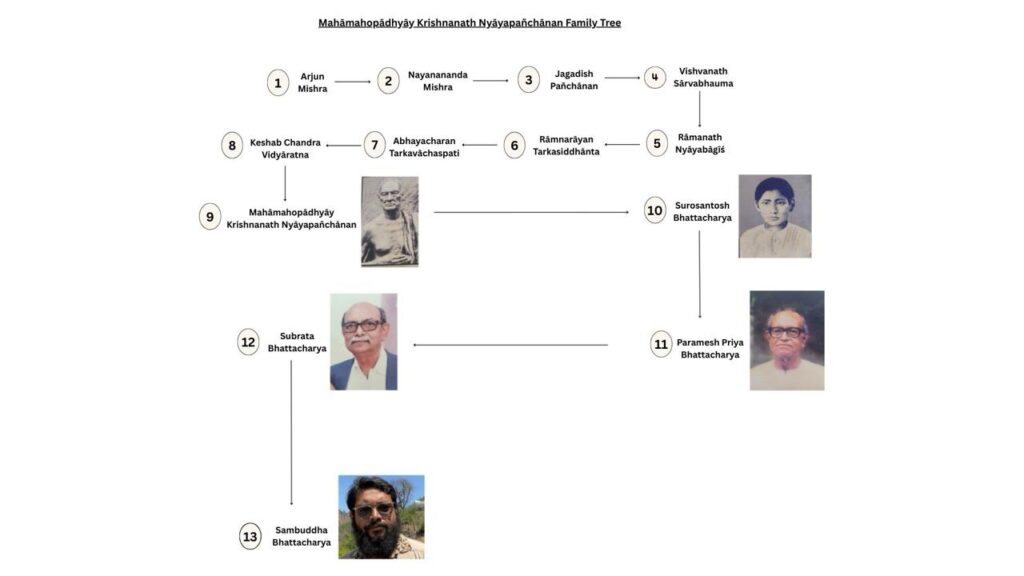
Family Tree (Thirteen generations from Arjuna Miśra)
→Arjuna Miśra (Mithilā → Navadvīpa; commentator on Mahābhārata)
→ Nayanananda Miśra
→ Jagadīśa Pañchānan
→ Viśvanātha Sārvabhauma
→ Rāmanātha Nyāyabāgīśa
→ Rāmanārāyaṇa Tarkasiddhānta
→ Abhayacaraṇa Tarkavācaspati (settled Purbasthali)
→ Keśab Chandra Vidyāratna (m. Kamalasundarī Devī)
→ Mahāmahopādhyāya Krishnanath Nyāyapañchānan (1833–1911)
→ Surosantosh Bhattacharya (1892 – 1918)
→ Paramesh Priya Bhattacharya (1915 -1998)
→ Subrata Bhattacharya (1956 – 2021)
→ Sambuddha Bhattacharya (1987 – )
Catalogue of Works :
(I) Devotional & Kāvya
● Vātadūtam (1272 B.E.) — dūtakāvya with self-commentary
● Śyāmasantoṣa (1298 B.E.)
● Kapūrādi-stotra (commentary; 1265 B.E.)
(II) Classics (Sanskrit drama) — commentaries
● Abhijñānaśākuntalam (1274 B.E.)
● Mālavikāgnimitram (—)
(III) Dharma & Smṛti
● Smṛtisiddhānta I, II, III (1312/1314/1316 B.E.)
● Dāyabhāga (commentary; 1293 B.E.)
(IV) Philosophy (Darśanas)
● Vedānta-paribhāṣā (commentary; 1296 B.E.)
● Arthasaṅgraha (Mīmāṁsā; 1305 B.E.)
● Mīmāṁsā-Nyāya-prakāśa (1306 B.E.)
● Tattvakaumudī (Sāṅkhya; 1309 B.E.)
(V) Language & Grammar
● Bṛhammadghabodha-vyākaraṇam (1301 B.E.)
Pricing for his printed books was kept lowest possible—publishing as seva, not commerce—attested in correspondence with Īśvar Chandra Vidyāsāgar.
Daily Discipline
● Ahnikā & Sandhyā at dawn → teach till 11 AM → bath & meal → correspondence → afternoon/evening teaching → sandhyā → writing till 1:30 AM.
● One meal/day, lifelong vegetarian; even in old age walked 10–12 miles with ease.
● Rule: No rulings against śāstra; no greed; no sale of knowledge.
Community Impact (then → now)
Village infrastructure
● High school founded (with local leaders) → today’s Nilmoni Brahmachari Institution.
● Post office & sub-registry secured; charitable dispensary seeded → primary health center.
Judicial & social ethics
● Set a bar for evidence-based, scripture-consistent adjudication; resisted monetary pressure.
● Modeled learning with service: free lodging/food for resident students; annual prize-winning results.
The Continuum of Seva (Family Contributions)
● Śrīmatī Niharbasinī Devī (Daughter-in-law) — Land donor for Krishnanath School: education for all, made concrete.
● Śrīmatī Kalyānmoyī Devī — Land for Purbasthali Hospital & Buro Mā Mandir: health and spiritual anchor.
● Parameśh Priya Bhattacharya (Grandson) — Teacher, co-op founder & first president; public water tap secured; land for today’s “Bagdi” colony—inclusion with dignity.
● Śubrata Bhattacharya (Great- grandson) — Founded Purbasthali Board Mill: local employment through skill-based industry.
From land for schools & hospitals to finance, water, and industry, the family stitched dharma into the daily fabric of Purbasthali.
Timeline (display as a vertical ribbon)
● c. 16th century: Arjuna Miśra (Agniveśya gotra; Pashchattya Vaidika Brahmin) settles in Navadvīpa.
● 1833 (1240 B.E.): Birth of Krishnanath at Purbasthali.
● 1860s–90s: Teaching, publications, tribunals, institution-building.
● 1891: Conferred Mahāmahopādhyāya.
● 1906: Paṇḍitakula-Chakravartī at the Śrī Bhārat Dharma Mahāmaṇḍal session.
● 1911 (26 Agrahayan, 1318 B.E.): Mahāsamādhi at Manikarnikā Ghāṭ, Kāśī.
● 20th c. onward: Family sustains education, health, inclusion, enterprise across Purbasthali.
● Today: The lineage animates SRB Multiversal—industry, agriculture, commerce, learning, technology, community uplift.
SRB Multiversal Pvt Ltd is a Dharmic holding company from West Bengal, shaped by the scholarly lineage of Mahāmahopādhyāya Krishnanath Nyāyapañcānana (1833–1911) of Purbasthali, Navadvīpa—uniting industry, agriculture, commerce, learning, technology, and community uplift under one spine: ‘धर्मो रक्षति रक्षितः’, that serve humanity, soil, and society.